

Privatizing Survival
America handed its vital systems to private owners. Now public survival depends on corporate choices, shareholder math and trusting the oligarchs to do the right thing.

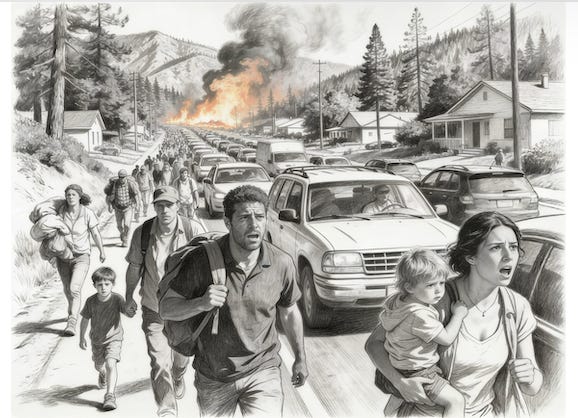
On the morning of November 8, 2018, Paradise, California woke up to wind.
Then smoke.
Then fire.
The Camp Fire came fast, hard and hungry, pushed by violent winds through dry brush and into a town full of people who had only minutes to understand that they were at extreme risk. The single route out of the mountain town quickly clogged with cars. Homes burned. Cell service failed. People abandoned vehicles and ran. Some never made it out.
By the time the fire was contained, Paradise had been nearly erased. Eighty-five people were dead. More than 18,000 structures were destroyed. More than 50,000 people had been displaced. California’s deadliest and most destructive wildfire had turned a thriving town into ash.1 Cal OES later reported that most of the destruction happened within the first four hours.2
The fire did not start because a volcano erupted, or a lightning storm rolled in or God reached down with a match because he hates California.
It started with a private utility company’s old, outdated and faulty equipment.
Cal Fire found that electrical transmission lines owned and operated by Pacific Gas and Electric caused the Camp Fire. The Caribou-Palermo line that sparked the Camp Fire was nearly a century old, had known age-related problems, and PG&E had delayed repair and upgrade work for years. State investigators later found an “overall pattern of inadequate inspection and maintenance” and said a timely close-up inspection and replacement of the worn C-hook could have prevented ignition of the Camp Fire. PG&E pled guilty to 84 counts of involuntary manslaughter and one count of unlawfully starting a fire.3
Paradise is what “privatizing survival” looks like when the abstraction catches fire.
A private company owned the wires. A public town lived beneath them. The danger sat in the gap between those two facts.
PG&E managed infrastructure, liability, maintenance costs, regulators, and investors. But the town held the risk. When the private utility’s maintenance decisions became real, they came racing down the hill in flames. They wiped out a town and killed its residents.
This is not just a California story. This is how America is built now.
The Government Accountability Office, or GAO, is Congress’s watchdog. It says the majority of critical infrastructure in our country is now owned and operated by the private sector. The systems so vital that their failure can cripple national security, public health, safety or the economy belong to board members and corporate interests. Safety systems that we all rely on have been turned into line-items on balance sheets where minimizing maintenance expenses maximize shareholder profits.
If private companies own and operate the infrastructure that keeps the country alive, then public safety depends on private cooperation, private investment, private competence and private willingness to put national stability ahead of quarterly returns.
Raise your hand if you believe corporations put you above their shareholders interests.
The danger is not simply that private companies can fail. Even government services can fail. The danger is that privately owned survival systems create divided loyalties.
The public needs resilience.
The company needs revenue.
The public needs redundancy.
The company needs cost control.
The public needs safety.
The company often gets rewarded for doing only what regulators can force, shareholders will tolerate and executives can justify.
The Stakes
We’re not only talking about power, though that’s one of the biggest by far.
But we are also seeing water, food production, banking systems, phones, roads, rail, hospitals, prisons, pipelines, Internet, payment systems, EMS and digital networks all moving into private hands.
The stuff we touch every day and forget to notice because it is supposed to work. The stuff that must work in order to have a functioning society. That’s what “critical infrastructure” means in plain English: the systems that keep a modern country alive.
Survival Became a Business Model
Survival has been turned into a business model in our extreme capitalist society. What was once thought of as services we came together as a nation to create and support has been turned into profit centers for extracting payment for our very survival.
Power becomes a revenue stream and keeping it safe or up to date is a cost that eats into profits. Water becomes an asset class. Health care a billing maze designed to confuse, delay, deny and extract profit from pain. Food distribution is a logistics empire dominated by eight private giants.4 Digital communication is in the hands of private gatekeepers; men rich enough to mistake themselves for entire nations.
The public needs these systems to be safe, stable, redundant and accountable.
Private owners need them to be profitable.
There’s your conflict, dear reader.
When survival systems become profit systems, the question is no longer “what keeps people alive?”
The question becomes “what can we delay, cut, automate, consolidate, outsource, underpay, deregulate and still get away with?”
And those decisions affect our very lives.
The National Security Problem
It’s not just a domestic policy problem. It is a national security problem.
Foreign adversaries do not need to roll tanks through Pennsylvania Avenue if they can hit the systems that keep the country moving. Russia can target pipelines. North Korea can target hospitals and payment systems. China can shut down ports, power grids, water systems and telecom networks.5
A modern invasion does not always look like soldiers at the border.
Sometimes it looks like a hacked billing system, a frozen pipeline, a disabled port, a contaminated water supply, a dead cell network and a government begging private companies to please, pretty please, keep the country functioning.
Public Power
And that brings us to the real question.
What does democracy mean if the people can vote for leaders, but not control the systems that keep them alive?
What does sovereignty mean if the country’s lifelines are privately owned, privately managed, privately guarded and publicly rescued after they fail?
A republic that cannot control its own survival systems is not fully sovereign.
It is dependent.
It is exposed.
It is one bad quarter, one hacked server, one neglected line, one bought regulator, one billionaire tantrum, one corporate failure away from discovering that our flag was flying over someone else’s machine.
—Lady Libertie
If this piece helped put words to what so many of us are feeling, you can support this work with a coffee or, better yet, an annual subscription. It helps me keep doing this independently, following the thread, and telling the truth as I see it.
California Department of Forestry and Fire Protection. (2026). Top 20 deadliest California wildfires. CAL FIRE.
California Governor’s Office of Emergency Services. (2019, November 19). State of California, partners commitment to Camp Fire recovery. Cal OES News.
Pacific Gas and Electric Company. (2020, June 16). PG&E statement on company’s guilty plea related to 2018 Camp Fire. PG&E Corporation.
Food distribution is heavily concentrated among large private distributors, including Sysco, US Foods, Performance Food Group, McLane, Gordon Food Service, UNFI, KeHE, and Dot Foods. Together, these companies control much of the logistics layer that moves food through restaurants, hospitals, schools, grocery stores, convenience stores, and other institutions. That concentration makes food distribution a private chokepoint in a public survival system. Food Logistics. (2025). Top food distributors.
Russian-linked criminals already showed what happens when a pipeline goes dark. The Colonial Pipeline ransomware attack sent people across the East Coast into gas lines and turned a private company’s cyber failure into a public emergency. CISA called it the moment critical infrastructure vulnerability became a kitchen-table issue. Cybersecurity and Infrastructure Security Agency. (2023, May 8). Attack on Colonial Pipeline: What we’ve learned & what we’ve done over the past two years. U.S. Department of Homeland Security.
North Korea has targeted hospitals and health-care systems with ransomware, according to CISA, and the Justice Department charged a North Korean hacker in a scheme that hit U.S. hospitals and used ransom proceeds to fund more intrusions. Cybersecurity and Infrastructure Security Agency. (n.d.). North Korea cyber threat overview and advisories. U.S. Department of Homeland Security.
China’s Volt Typhoon has already compromised U.S. critical infrastructure organizations in communications, energy, transportation, and water systems, according to a joint CISA advisory. Cybersecurity and Infrastructure Security Agency. (2024, February 7). PRC state-sponsored actors compromise and maintain persistent access to U.S. critical infrastructure. U.S. Department of Homeland Security.
Lady Libertie brings up important points.
First, private ownership of electric grid and telecommunications infrastructure was predicated on a compact, dating back to the early 20th century, with government that the corporate owners were responsible to protect the public interest, and would submit to government oversight and regulation. In exchange, they became among the wealthiest, most stable corporations in the US (AT&T, Con Edison etc.) As a former utility regulator, and later, a utility regulatory and government affairs professional, I can attest that this compact was taken literally inside utilities. Many electric utilites were managed by Navy veterans, who had a lot of experience with power systems, and they took protecting the nation most seriously. During the Reagan administration, the kleptocrats finally succeeded in cracking open the vault of public money and weakening regulations. That ongoing operation has been particularly damaging to the US in the utitlity and financial sectors.
Second, the high tech sector has managed to create a new technology infrastructure entirely without government oversight. That has allowed them to have outsized power and control over the nation's businesses, and is now building itself into an out-of-control monolith intended to crush and control citizens with AI and massive data center. This must be stopped at all costs.
Third, the role of the foreign influence operation, what Anne Applebaum calls Autocracy, Inc., cannot be overstated. It would be theoretically possible for the kleptocrats to be Americans who help themselves to public money, while simulataneously protecting the US from foreign adversaries. That is not what is happening. The current batch of authoritarian kleptocrats are explicitly stealing money, deliberately destroying the economy, impoverishing citizens in every way possible, damaging the food supply, trying as hard as possible to make citizens sick, and crushing the federal government's ability to protect the nation against theft, famine, plague, and cyber attacks. The situation is that a foreign influence operation has decapitated the federal government, installed an authoritarian kleptocracy, and is in the process of razing the US to the ground. They must be stopped, either the easy way or the hard way, whatever it takes.
This is really on point. As a CA resident, I continue to be astonished that electrical lines in heavily wooded or grassy areas are not undergrounded to prevent wildfires due to heavy winds. After the Paradise and Santa Rosa fiascos, PG&E *finally* started doing just that, but mostly for PR reasons and because the legal payouts to the government and families who sued started to become more costly than just doing the work. My motto is never to trust any company that has to do an ad campaign to convince the public they are doing right by them.