

Rent the World
The subscription economy is coming for everything you own

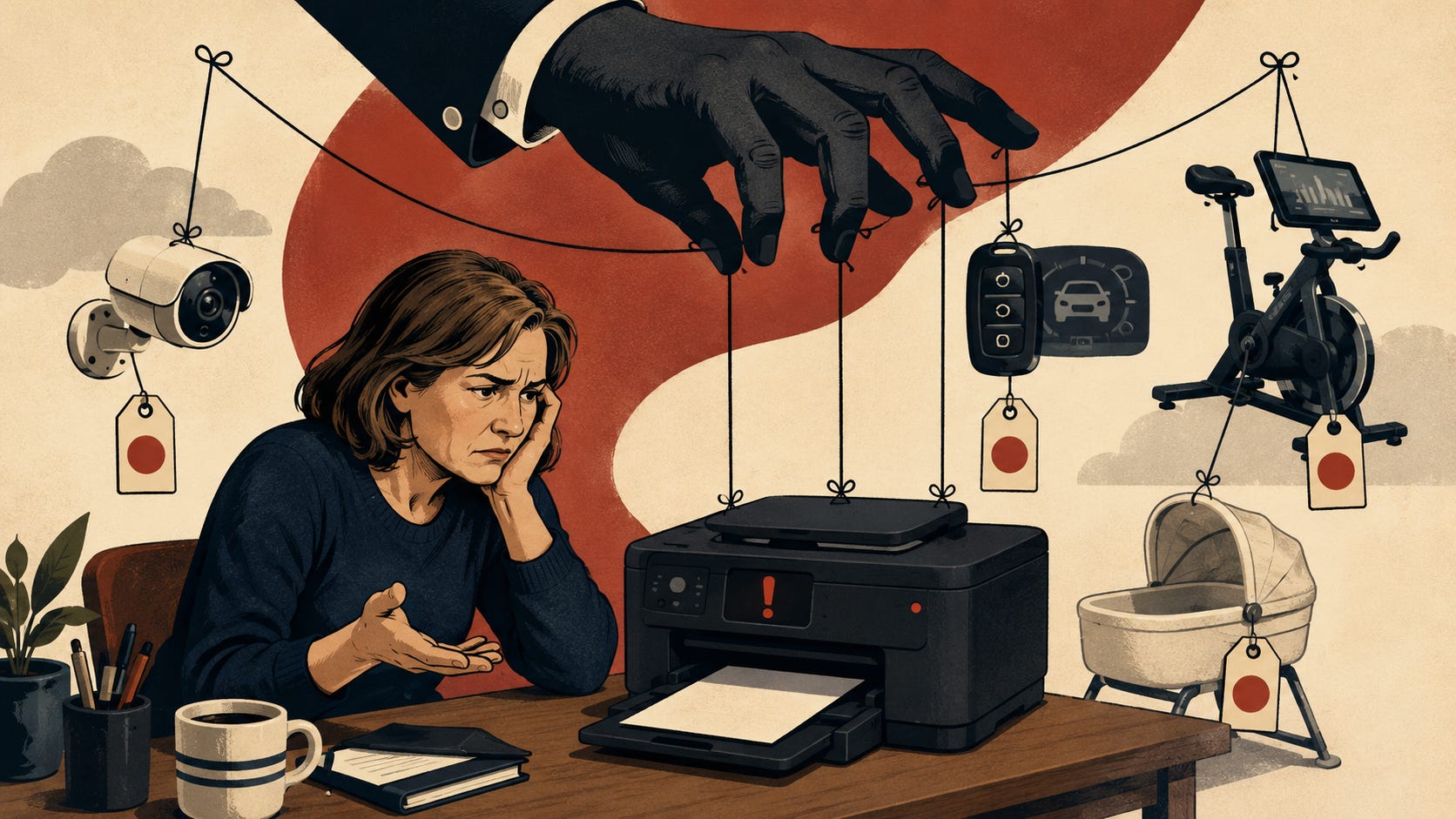
I recently ran across a TikTok of a woman dissolving into a tearful rant of tech-rage at finding that her 5-year-old HP printer had suddenly demanded to have access to the internet. Once it did, it updated the operating system and told her she wasn’t allowed to print anymore.
The updated firmware had detected that she was using off-brand ink cartridges. The kind that are many times cheaper than the HP cartridges. Because HP would prefer customers buy their overpriced ink, instead of going after the competition by, oh I don’t know…COMPETING, they’ve decided to go after their customers.
For five years this woman had been happily using her HP printer and cheaper ink until the company demanded she make changes so they could have access to reach into her home, into her computer, and stop her use of a competitor’s ink.
The sheer audacity!
But wait, there’s more!
If you think that’s just a particularly egregious rare example of corporate overreach and unbridled greed, you’d be wrong. There is a growing list of examples of corporations demanding consumers pay a monthly fee for features and products that had been purchased outright.
BMW notoriously required a subscription from its customers to use the heated seat feature in the cars they’d bought. Customers were outraged and BMW was forced to drop the fee. But other companies were watching over the fence and their eyes were twinkling.1
Ring will sell you a camera to spy on your neighbors, but won’t save the video to watch later. So really, not much of a security camera without the feature, since not all of us are sitting around waiting to watch the live feed of the Amazon delivery guy, Steve, whose dog always pees on our hedge, or Oscar, the mow & blow guy’s arrival and departure. That will cost the customer $4.99 a month.2
Tesla has perfected the model of sell the car with the hardware; retain software control over what that hardware can do; then require the owner to keep paying for continued access. Features that require an extra subscription includes their famous Full Self-Driving. If you want your car to get you to Whole Foods and back without touching the steering wheel, that will cost you $99 a month.3
Peloton sells expensive bicycles, treadmills and rowing machines, then charges owners for continuing access to the classes, performance tracking, leaderboards, programs and much of the experience that distinguishes the machine from an ordinary (much much cheaper) exercise bike or treadmill.4
There are continuous glucose monitors sold with app memberships; bassinets that stop rocking your baby if you stop paying $19.99 a month.5 Smart scales that require premium payments. Plus blood-pressure devices, sleep trackers, fertility monitors, hearing devices and vacuum cleaners that all have limited or no use without the subscriptions that enable their features.
Instead of competition, they’ve chosen extortion
OK, fair enough. If you designed a weight-loss program and software to track all the biometrics your custom scale can read, who am I to throw cold water on your monthly rental business model? I can live with the openly disclosed product-plus-subscription model.
Tell me upfront that this is what you’re really selling: a fancy scale with software to track my weight loss journey. I might just buy that.
Or sell me a product that turns out to be mostly unusable without the monthly fee—like a security camera that’s only useful if I’m home and actively looking at my feed. Then I’m not going to be happy.
I’ll feel cheated.
But sell me a premium product and only after I’ve bought it (maybe even 5 years later) tell me that it’s not going to work unless I agree to your ongoing fees? I too will be on TikTok in a tearful rage telling the world about your shitty, extractive and grifting business practices. It’s the underhandedness of these own-to-rent programs that really sticks in my craw.
These are companies that refuse to innovate or compete and instead have chosen extortion.
The move from ownership to revocable, nontransferable, manufacturer-supervised access
Instead of a healthy free market competition, instead of being happy with the monopoly many of these companies already have, our corporate overlords are now looking for ways to reach into our pockets and extract even more.
And ownership itself—the hallmark of a free capitalist society—is rapidly going extinct.
We all think we know what it means to own a physical thing. But these four basic rights of ownership are rapidly changing in our country. Once they’re gone, will there be anything left that we actually own?
Four rights of ownership
The right to use
We used to buy a product and use it however we saw fit. Now, manufacturers can remotely decide which functions remain available in the product you think you own.
The right to repair
Want to take your truck to Joe on the corner who has been repairing your vehicles for the better part of 30 years? The car companies want to stop that.6 They’re trying to pass a law that new cars have to be repaired by the dealership. Even now they can reserve diagnostic software, parts and authorizations so Joe can’t work anymore.7
The right to modify
We’ve long been used to software locks that prevent us from changing the product or using compatible third-party components. That’s becoming more and more widespread and companies use you and your purchase to muscle out fair competition. The newest form of monopolistic bullying.
The right to resell
When you physically own a piece of property, you have the right to resell it. This right goes back to copyright law and the first-sale doctrine: if you legally buy a particular copy of a book, you may resell that copy without getting the publisher’s permission or paying another fee.8
Software-controlled products are beginning to hollow out that right. Paid features (like that self-rocking bassinet) may not transfer to the next owner, or the next owner may be required to pay the manufacturer.
It’s only a hop-skip and a jump to requiring used bookstores to pay publishers a second fee anytime a book is resold. Then apply the same rule to everything else we sell. The old phone on eBay, the couch on Craigslist, the exercise bike on Facebook Marketplace. Every resale becomes another chance for the original manufacturer to stick out its hand and demand a payment.
At that point, do we really own anything? Or are we just the first in a line of renters?
What are people doing to push back?
There are a few tactics that work pretty well.
Complaining—works a little
Some of the more egregious examples of corporate overreach were cancelled when customers rose up in fury. BMW quit charging a monthly fee for heated seats. Customers were naturally outraged to find themselves paying the company to stop preventing electricity from reaching equipment already inside the car.
But other companies endured the complaints and boycotts and just kept charging. So don’t count on this as a solution.
Hacking and bypassing restrictions—works if you’re tech-savvy or have an eng friend
Some clever hackers have developed workarounds to turn off security features in operating systems, silence security features that check for licenses, and jailbreak everything from phones to design software.
This creates an arms race, though: corporations tighten software locks; customers seek jailbreaks, unofficial firmware, replacement chips and independent repair tools.
Political action—The Right to Repair movement is growing stronger
You may have heard of this movement and wondered what the heck that was. I myself imagined revolutionaries in back rooms subversively repairing their toasters.
It’s much bigger.
Right to Repair advocates argue that ownership must include practical access to parts, tools, diagnostics and independent repair companies. Our good buddy Joe the mechanic shouldn’t be out of business because Ford forces us to use the very expensive dealer’s mechanics.
These consumer groups are now trying to extend that logic beyond just repair. Their proposal is that all products should have:
a disclosed minimum support period;
core functions that survive without an internet connection;
a workable end-of-life plan (the thing’s life, not your life);
and the ability to reuse or modify the thing when brand support ends.9
You know, all the stuff we used to have before end-stage capitalism took away our nice things.
My plan is never to buy another car since my 20 year old Jeep is repairable, runs great, and doesn’t spy on me. What’s your plan?
—Lady Libertie
If this piece helped put words to what so many of us are feeling, you can support this work with a coffee or, better yet, an annual subscription. It helps me keep doing this independently, following the thread, and telling the truth as I see it.
Bierenkoven, C. (2023, September 27). BMW’s heated-seat subscription is dead; others live on. Edmunds.
Ring LLC. (n.d.). Ring Protect subscription plans for home security.
Tesla, Inc. (n.d.). Full Self-Driving (Supervised).
Peloton Interactive, Inc. (n.d.). Compare Peloton membership tiers for apps and equipment.
Happiest Baby, Inc. (n.d.). Happiest Baby App premium features and pricing.
Spangler, T. (2026, June 5). Ford, GM pushing bill to restrict right to repair, Trump says. Detroit Free Press.
Federal Trade Commission. (2021, May 6). FTC report to Congress examines anti-competitive repair restrictions, recommends ways to expand consumers’ repair options.
U.S. Copyright Office. (n.d.). Resale royalty right.
Consumer Reports Advocacy. (2024, October 24). Consumer groups call on FTC to establish standards for software-tethered products.
We have a gas Jeep from 2003. Our big TV is from 2008. Our computers and phones are all mostly from 2021 or before. We intentionally buy used and analoge devices (pressure cooker with a weight, scales that keep our secrets, etc.) when we can because my partner is a engineer and a security nerd. It's not that I don't like new things - I do - but its more that we value our privacy more than the latest and greatest. It is not a sacrifice many people are willing to make yet, but we can see where this is going... and its nowhere good. The SmartWorld is a sleezy, extractive place, and we do not wish to live there.
I, too, plan to keep my older car. It's a 2014 and has less than 100,000 miles. 🤞 With good, regular maintenance by my independent mechanic I might be able to drive it the rest of my life. I'm 63. 😬